
Broomfield County Arrest Warrants Explained
An arrest warrant is a court order telling peace officers to take a named person into custody. Under C.R.S. §16-3-108, it has to rest on a sworn or affirmed affidavit. That affidavit must lay out enough facts for probable cause: that an offense happened and that the named person committed it. Probable cause is a sound factual basis for belief. It is more than a hunch, yet it falls short of the proof conviction demands. In Broomfield County, an arrest warrant can come out of District Court, County Court, or Municipal Court, depending on the matter. The judicial officer weighs the facts and signs if the standard is met. Once service occurs, the officer must bring the person before the nearest judge of a court of record without needless delay. The warrant authorizes custody. From there, the charge moves through the ordinary court process like any other.
Broomfield Affidavit-to-Docket Path
Broomfield County's local sequence begins with sworn facts, not an online entry. Police or a prosecutor files a complaint, information, or affidavit. A judge or magistrate then reviews it. If a Broomfield County arrest warrant issues, the clerk records the case activity and an authorized agency receives the warrant for service. Later, the public docket may show a hearing labeled “Appearance on Arrest Warrant.” That label is a useful lead. It is not a complete Broomfield County arrest warrant record, and it may leave out the affidavit, warrant number, issue date, bond terms, or current active status. Search the Broomfield-filtered state docket first. Then call the Combined Courts clerk at 303-464-5020 with the case number, full legal name, and date of birth, and ask which division owns the matter. The official court source lays out how court contacts are organized, so review the Broomfield Combined Courts page before using its contact panel.
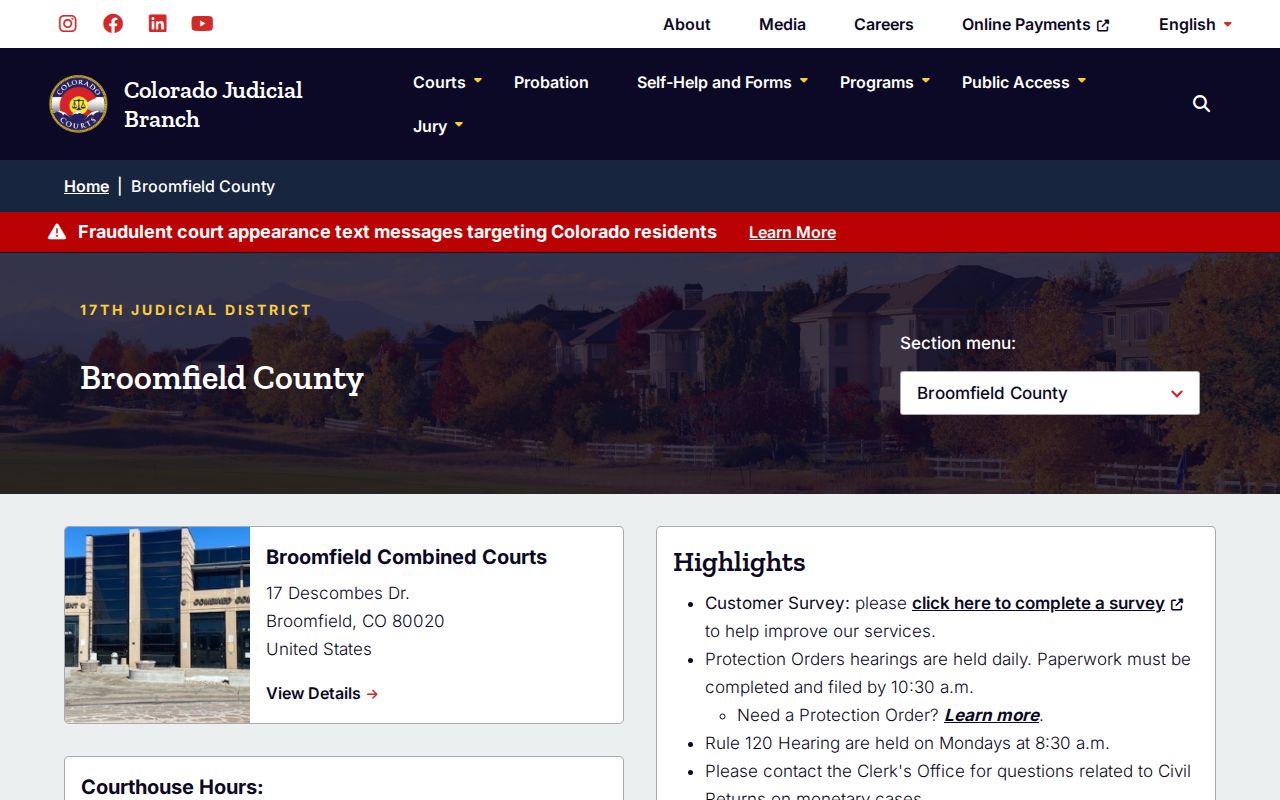
The panel points searchers back to the Broomfield County clerk, who can confirm the issuing division and pass along current instructions.
Inside a Broomfield County Arrest Warrant
Broomfield County publishes no universal public warrant-number format. Colorado case numbers combine a year, case class, and sequence, like the format-only sample YYYYCR###. That pattern is a case number, not proof a warrant exists. A court file, a law-enforcement return, and a booking record can each show a different slice of the same process.
| Named subject | The person identified in the arrest command, with other identifiers where release is allowed. |
|---|---|
| Case number | The court identifier used to locate the criminal matter and its docket. |
| Charge and statute | The alleged offense, legal citation, level, or plain-language description. |
| Issuing authority | The Broomfield court, division, judge, or magistrate controlling the warrant. |
| Agency and dates | The serving agency plus issue, return, service, booking, or hearing dates when recorded. |
| Bond and status | Any cash, personal recognizance, surety, no-bond, active, served, recalled, or quashed notation. |
Sealed, juvenile, and investigative limits can keep some Broomfield County arrest warrant material out of public view. An empty result does not establish that no warrant exists.
Broomfield Arrest Warrant Authority
Broomfield County works through three court levels. The 17th Judicial District's District Court controls felonies and other cases within its general jurisdiction. County Court handles misdemeanors, petty offenses, state traffic matters, bail, and preliminary felony work. Broomfield Municipal Court takes city ordinance, municipal traffic, parking, animal, code, and municipal misdemeanor cases.
Broomfield Combined Courts
District and County Court clerk route for state cases at 17 Descombes Drive.
303-464-5020
Broomfield Municipal Court
City-case clerk for municipal warrant questions at 17 Descombes Drive.
720-887-2100
Broomfield Police Department
Local police agency that also serves as sheriff for Broomfield County.
303-438-6400
Colorado adds no Broomfield County justice-of-the-peace layer. Ask the clerk to name the exact court and division rather than assuming every arrest warrant belongs to District Court.
Serving Arrest Warrants in Broomfield County
The Broomfield Police Department serves as both city police and county sheriff. It is the main local service and custody channel for Broomfield County arrest warrants. Other Colorado agencies may serve a warrant when contact happens elsewhere, and federal officers handle federal process. Service leads to arrest, booking, judicial review, and bond or release decisions. Court Security at the courthouse does screening only; it is not a warrant-confirmation desk. If someone is already in custody, the Broomfield Detention Center line at 720-887-2000 can give booking, charge, bond, and next-date information, and the official inmate page links current custody tools. Someone missing from those tools could still have an unserved Broomfield County arrest warrant, because booking reports cover only people in custody. That interface is a post-arrest resource, not a warrant search.
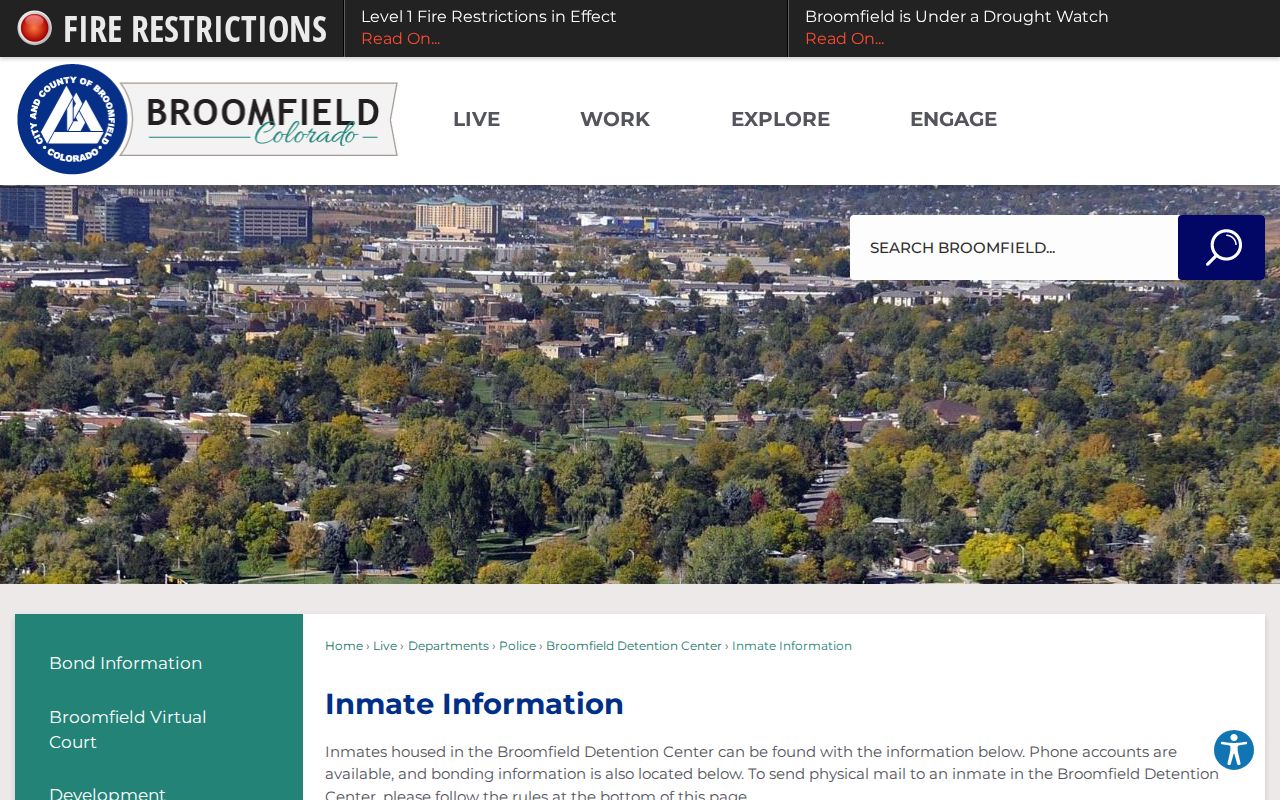
Because its custody role is so narrow, court confirmation has to come before any conclusion about an unserved Broomfield County warrant.
Broomfield Sealed Warrant Limits
A sealed warrant or indictment may never reach an ordinary public docket. Colorado public-access rules also shield juvenile identifiers and can restrict investigative material. The Colorado Criminal Justice Records Act governs police criminal-justice records, while court rules and orders govern court access. Even with complete identifiers supplied, a clerk may be unable to disclose a sealed Broomfield County arrest warrant.
Key point: No public result is not warrant clearance; only the issuing court can confirm what it may lawfully disclose.
BPD Records at 303-438-6420 is the formal police-record route for Broomfield County. Its process concerns releasable existing records, not the creation of a new clearance report. General City and County records use CORA and JustFOIA, but Broomfield's policy excludes criminal-justice records governed by CCJRA. For a state arrest warrant, the state court clerk remains the first route.
Comparing Arrest, Summons, and Bench Warrants
Broomfield County courts use three tools that people mix up. An arrest warrant needs probable cause. A summons just orders a person to appear, with no custody attached. A bench warrant enforces a missed date, a release term, or another duty in a case already open, so each tool calls for a different response.
| Feature | Arrest Warrant | Summons | Bench Warrant |
|---|---|---|---|
| Core order | Arrest the named person | Appear on a set date | Bring the person back to court |
| Basis | Sworn facts and probable cause | Charge handled without initial custody | Missed appearance or noncompliance |
| Typical step | Court-directed surrender or bond | Attend as commanded | Ask about recall or bond |
| Case effect | Starts or advances the case | Keeps an appearance track | Does not prove a new offense |
Miss that summons date and it becomes a failure to appear. The Broomfield County bench warrant search page walks through that existing-case process.
Broomfield Warrant Bond Records
Bond is a release condition. It is not payment of the charge. Colorado allows cash, personal recognizance, professional surety, and property bonds. A judge decides which types and conditions apply in Broomfield County. The state bond page says form JDF 370 Appearance Bond may be used to cancel a warrant or release a person from custody. Still, the form does not guarantee a Broomfield County arrest warrant clears without a hearing. Exact cash may be paid at detention, according to the Broomfield bond page. Card payments require the Broomfield Police Detention Center location, code PLC #a003fz, the amount, and the person's name. A licensed bondsman is another route. Staff do not recommend a firm. Keep the paperwork. Track the next court date, because posting bond covers release and appearance only and does not dismiss the underlying Broomfield case.
If There's an Arrest Warrant for You
Call the issuing clerk first. Ask about the Broomfield County arrest warrant type, case number, division, bond status, next hearing, and exact instructions. Recall means the court withdraws it. Quash means the court sets it aside by order. A lawyer can seek either step, and counsel may also arrange a controlled walk-through or voluntary surrender when the court permits one.
- Confirm the warrant through Combined Courts or Municipal Court, not an unsolicited caller.
- Ask whether the court requires an appearance, motion, surrender, or approved bond.
- Obtain instructions before going to court, police headquarters, or detention.
- Keep the signed order, bond papers, receipt, and next-court-date notice.
- Call again to confirm the warrant is recalled, quashed, or served.
Important: Speak with a lawyer before surrender; an active Broomfield arrest warrant can result in custody during any police contact.
Confirm Broomfield Warrant Recall
A docket entry is not a recall order. Neither is a bond payment or a records request. After any court action, ask the clerk whether the Broomfield County arrest warrant was recalled, quashed, served, or otherwise cleared. Ask when the court and agency systems will reflect it. Save written proof. Record which office confirmed it and on what date. If booking was involved, detention may confirm release and bond data. It does not control the court's warrant order. BPD warns that officers never call demanding payment for a warrant or a jury-duty failure to appear. Hang up. Then dial a published number. Broomfield runs no amnesty day and no universal walk-in warrant window, so ordinary court instructions remain the reliable route. Note: Clearing the arrest warrant does not close the criminal case; every later hearing and release condition still applies.